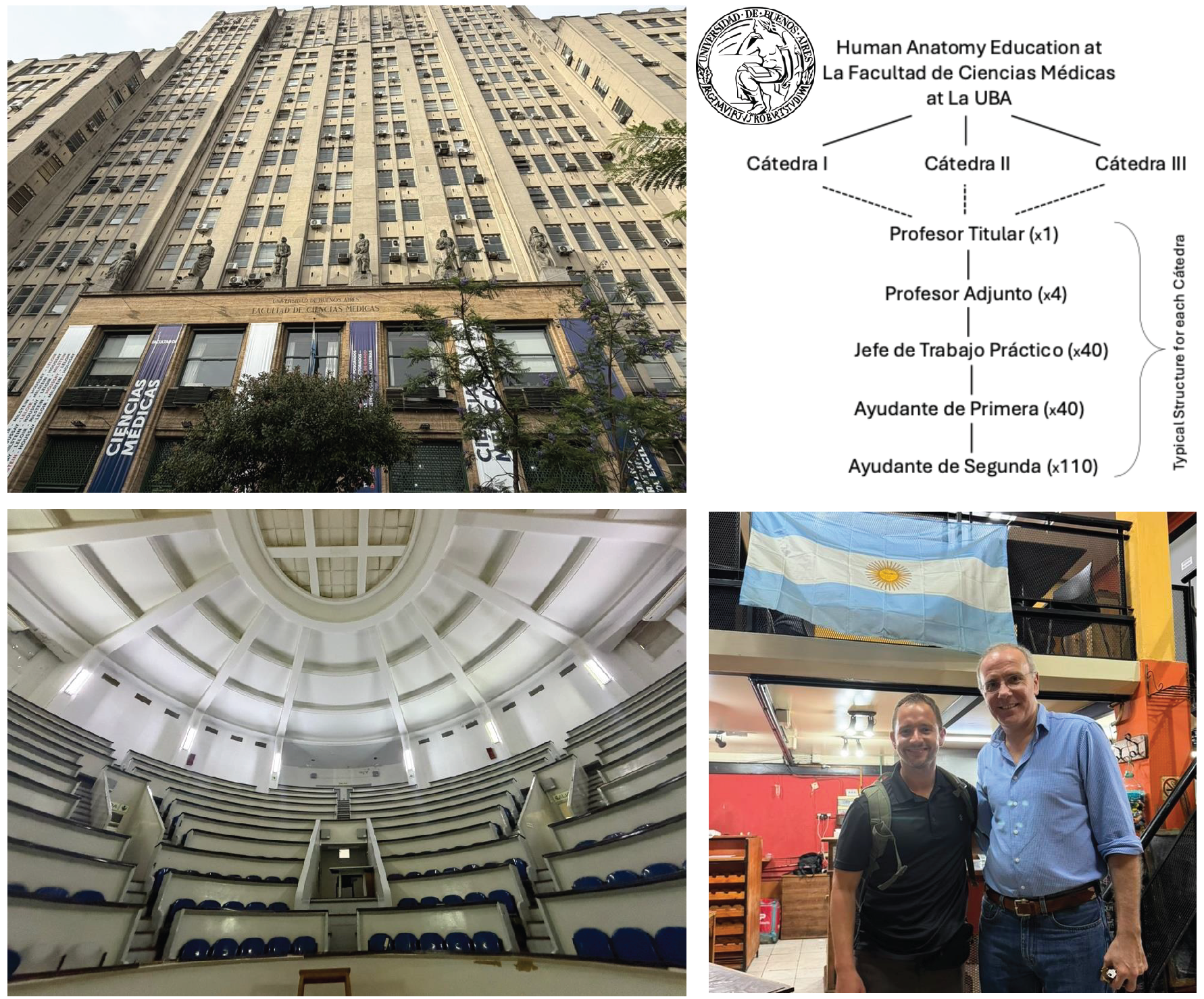
Can you imagine teaching human gross anatomy to 8,000 students in your first-year medical class? That’s precisely the task for the faculty at La Facultad de Ciencias Médicas at La Universidad de Buenos Aires (La UBA) in Buenos Aires, Argentina. La UBA is a tuition-free, public institution, reflecting a long-standing principle in Argentina that higher education is a public good. Many of their students are natives of Argentina, while a meaningful contingent comes from other South American countries including Ecuador, Brazil, Chile, Venezuela, Bolivia, and Colombia.
Students entering La Facultad de Ciencias Médicas at La UBA typically come directly from high school. Similar to the European model, they do not first complete an undergraduate degree before beginning medical training. Instead, they begin a 6.5-year medical program. Prior to full enrollment, students must complete the Ciclo Básico Común (CBC), which includes biology, biophysics, chemistry, mathematics, and scientific thinking. The CBC provides scientific reasoning before disciplinary immersion, serving as a structured pre-med year and readiness assessment for the rigor of medical studies. Following completion of the CBC, the Ciclo Biomédico consists of two years of intensive biomedical study, including anatomy, histology, embryology, and genetics in the first year.
For anatomy, the course runs one academic year (March through early December). While enrollment can vary, it is not uncommon to have between 7,000 and 11,000 students remaining after their CBC year. So how does the faculty accommodate so many students? Firstly, the students are divided into one of three chairs (cátedras), which serves as their dedicated site of anatomical study. Thus, assuming an average of 8,000 total students, there are approximately 2,700 students per cátedra. Then, the faculty employs a hierarchical approach to teach laboratory sessions, in which there are nearly 200 laboratory instructors per cátedra with various ranks. The faculty hierarchy (pictured below) includes full professors, associate professors, and senior practical instructors (jefes de trabajo práctico), all of whom are further supported by ayudantes (or teaching assistants). The senior practical instructors are often junior physicians, while the ayudantes are often advanced medical students who return to help facilitate laboratory sessions.
The anatomy curriculum is split into three overarching blocks, including Aparato Locomotor, Esplacnología, and Neuroanatomía. These blocks reflect a regional approach common in traditional gross anatomy curricula, progressing from musculoskeletal structures to internal organs, culminating in a detailed study of the central nervous system. Each block includes nine practical sessions and concludes with a combined theoretical-practical examination. Students also must pass a comprehensive final examination to complete the course. To accommodate their large student body, cátedras schedule extended lab sessions throughout the term; in fact, it is not uncommon for the teaching team to work from 8:00 AM to 10:00 PM several days a week to educate all students. Moreover, regional differences in donation practices limit the number of whole-body donors available for instruction each year. Nonetheless, the dedicated teaching team within each cátedra overcomes these obstacles annually to deliver a high-quality human anatomy education at one of the most prestigious medical institutions in South America. The scale alone is impressive, but it is the sustained organization and instructional commitment that make it extraordinary.
As a new member of CECA within the American Association for Anatomy, I have compiled this blog to highlight our talented, passionate colleagues across the Americas. I would like to extend special thanks to Dr. Bruno Buchholz (Cátedra I) and Dr. Valeria Forlizzi (Cátedra II) for their generous hospitality during two visits in 2023 and 2025, which provided invaluable insight into anatomy education efforts at La Facultad de Ciencias Médicas at La UBA.